
















Inclusive financial services start with design
In her work, Marèl sees how financial processes are often implicitly designed for a specific group of users. “Many processes assume people are financially well-informed and digitally skilled. But that doesn’t apply to everyone. For people with lower incomes, limited digital skills, or a language barrier, the same processes can suddenly become much more complex.”
This means that formally similar processes can have different outcomes in practice. Petra sees the same mechanism in the pension sector. “A pension plan is neutral on paper,” she says. “But choices about working hours and careers do influence pension accrual. As a result, outcomes can differ in practice, for example, when one partner in young families reduces their working hours. This is still relatively often the woman.”
Digitalization can make financial services more accessible
Digitalization offers opportunities to make financial services more accessible. At the same time, there is a risk that existing inequalities will be unnoticed in digital systems. “If you don’t design consciously, you simply copy the inequalities that already exist in society,” Petra continues. “Many systems start from a single, standardized view of the user.”
Technology can also break that pattern. By testing different scenarios or testing models on multiple types of users, for example, better insight can be gained into how processes work out in practice. Marèl also sees this in schemes related to home sustainability. “In theory, everyone can benefit from subsidies. But in practice, you see that it’s mainly people with the time, knowledge, and digital skills who find their way. If you design processes simpler and more intuitive, you lower that barrier. Technology then helps broaden access to financial programs.
Assumptions in systems and data influence outcomes.
Many inclusion issues arise not from explicit rules, but from assumptions in systems, data, and processes. Petra cites a well-known example from another sector. “For a long time, car crash tests and safety standards were primarily based on male test dummies and male body measurements. That may seem like a minor detail, but it has had significant consequences for the safety of female drivers. Such assumptions can also seep into financial models.” For example, research shows that female entrepreneurs are more often questioned by investors about risks, while for male entrepreneurs, the emphasis is more often on growth and potential.
Language and system logic also play a role in accessibility. “The mortgage world is full of terms that are self-evident to professionals,” Marèl adds to her colleague. “Terms like annuity, fixed-rate period, or interest-only don’t make sense to many people. This is where UX design clearly plays a role. By critically examining language use, interaction, and user experience, you discover where people get stuck. That’s where you can make a difference.”
Diversity in teams improves financial solutions
Not only systems, but also teams determine how inclusive solutions ultimately become. Petra sees diversity in teams as a form of risk management. “When people from different backgrounds work together, they automatically look at the same issue from multiple perspectives,” she says. “That helps prevent blind spots.”
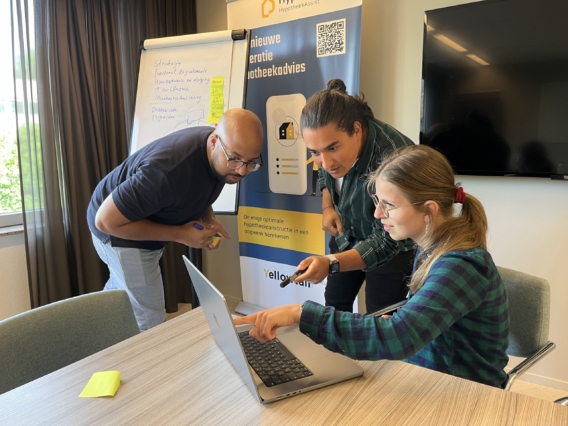
Marèl recognizes this from her own projects. “Our teams often consist of UX designers, consultants with market knowledge, and developers. This combination ensures that we look at issues more broadly.” She believes this is essential, especially for solutions that help consumers become more financially resilient. “The design must be substantively sound, but also understandable and accessible.”
The future of digital financial services
Looking ahead a few years, Marèl and Petra expect inclusion to become an increasingly explicit part of the design of financial services. According to Petra, this starts with broadening perspectives within teams. “When you have more diverse perspectives in teams, you automatically ask different questions. And that often leads to better solutions.”
Furthermore, designing digital processes requires a broader view of users. Marèl summarizes this in a simple design question: “Don’t design for one standard user, but for different life situations. That way, you make financial services more accessible to a wider group of people.”
Ultimately, it boils down to one fundamental question. For whom are we building financial services? Digital transformation often focuses on efficiency, automation, and technology. But the true quality of financial services reveals itself elsewhere: in systems, processes, and teams that consider the diversity of the people they are intended for.